Rage
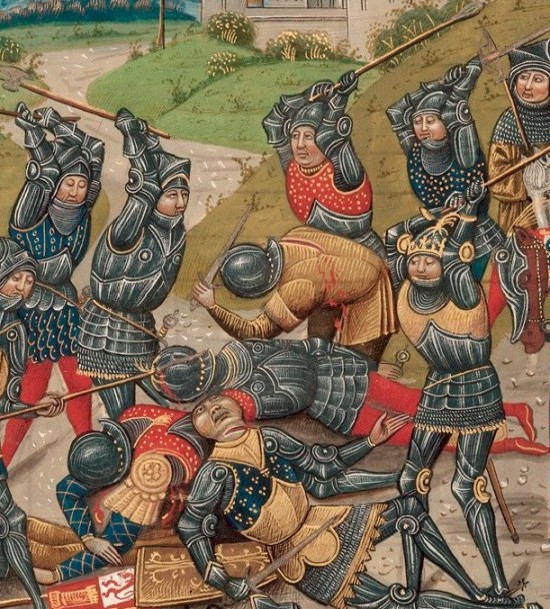
The Battle of Aljubarrota — Jean d’Wavrin, 15th century
Anger plagued my childhood. It afflicted everyone in my family. It was passed down to me, like a poisonous heirloom. I internalised it, I swallowed it, and in doing so, I cursed myself for years to come.
My father was a fierce disciplinarian. This was part and parcel with Chinese parenting. However, as a child, what disturbed me the most was how much he fought with my mother. My parents’ marriage was a battlefield. They warred over so many things. They bickered about money. They bickered about my father’s jobs and how little money they made. They bickered about my father’s costly smoking habit. They bickered about my father’s gambling problem, which he briefly had while we lived in Christchurch. They bickered about the grocery bills, the rent.
We were an unhappy immigrant family with little money. My father had experienced a traumatic loss of status when he emigrated overseas. Originally, he had been a lecturer at a top engineering university in China and had ended up in graceless, deadbeat jobs in New Zealand like pizza delivery. My mother also fell from grace, devolving from a factory manager into a checkout clerk. They felt a deep sense of shame, particularly compared to their siblings back in Asia who became wealthy in the late 1990s and early 2000s during the Chinese economic miracle.
For the longest time, I was incapable of loving my parents. Even as a young child, I resented them. Around age six, a primary school friend asked me whether I loved my mum and dad. “No”, I said, to my friend’s surprise. My parents were unhappy creatures that never showed affection towards each other, so it made sense I was cold to them in turn. They never seemed to have any hobbies or friends. They seemed incapable of integrating into kiwi society—in fact, they often voiced contempt at New Zealand culture and made little effort to fit in. How could I possibly love people like that? From a young age, I wanted them to be divorced. They were not meant for each other.
We lived in small rental flats and apartments, so their anger was magnified by confined spaces. The arguments often seemed to explode ex nihilo. One second they’d be having a calm conversation at the dinner table, the next they would be the faces of domestic chaos, swearing and screaming and red-veined and accusation-filled. The gates of hell would open in an eyeblink. My father had a penchant for smashing plates against the floors and walls of our homes. Sometimes, he’d smash plates full of food he’d just cooked. If the argument happened in the car while he was driving, sometimes he’d rapidly swerve or brake the vehicle to demonstrate his fury. (Perhaps my childhood trauma from this is why I still don’t have my license.) One evening, they were so blindly furious at each other, they had a smashing contest. They both began by obliterating dinner plates, then my mother snapped my father’s fishing pole, and my father responded by destroying the mugs and cups. All the while, I was in the corner of the living room, crying and begging them to stop. This didn’t work.
To his credit though, he never beat my mother.
My father’s rage ended many happy moments in my childhood. He’d berate my mother after we returned home from social visits to family friends. He’d ruin the end of the few family road trips we ever did with his tantrums. A standout memory I have is from the time we lived in government housing in Christchurch, on the third floor of a squalid, concrete apartment block. Their argument had become so feverish and terrifying that I ran out of the apartment in tears. I distinctly recall sitting in the stairwell in the dark, praying to God (I’ve been an atheist my whole life, by the way). “Please God,” I whispered, “I’ll believe in you if you make them stop arguing”. From the darkness, nothing answered back.
On rare occasions, a family friend from the Chinese community would come over after a nasty argument and mediate between my parents. But I hated those individuals too. Did they ever, at the end of their peacekeeping intervention, turn their head and ask how I, a small child, was doing? How I was feeling? How I was coping? They did not. In my opinion, those individuals, those chinks, were complicit in my ongoing misery.
There was also rampant hypocrisy in my parents’ behaviour. They constantly lectured me with empty words about always remaining calm, about always respecting your parents, yet never taught by example. During my primary school years, my paternal grandparents flew over to visit us once. Near the end of their trip, my parents had such a brutal argument that my grandparents—my father’s own goddamn mother and father—were incapable of calming him down. A few years later, when I was in high school, my maternal grandparents flew over to visit. Their trip was also dampened by a household quarrel. I can remember fleeing the house at night to a nearby park and being tailed by my maternal grandma. I sat gloomily in the darkness on a swing seat while my grandma sobbed and told me that she should have opposed the marriage, if only she had known at the time how awful my father’s temper was.
How does a child respond to such anger? In my case, I swallowed it like a poison pill. My emotions tracked his wrathful spoor and I quickly began to mimic my father’s rage. My parents knew this and feared their negative influence on me, so whenever I exploded and lost control at home, I was ferociously punished by both of them. Exasperated, they’d warn me that if I ever took my temper outside the house, I’d be mocked, ostracised, beaten up. Then after I was punished, my parents would turn on each other. Venomous accusations would fly across the room, each blaming the other as the source of my poor behaviour.
Because I couldn’t risk becoming angry at home for fear of punishment, I turned on my primary school classmates. My tantrums would terrify my school friends. When I was maybe eight, I once had to be held back by two friends from lunging at another child. “You can’t control me!” I howled. For me, anger was a perverse joy. It made me feel bigger. It made me feel powerful. By relinquishing all control to my inner fire, I felt like I had ownership over my life.
° ° ° ° °
When it became apparent that my parents were no longer in the mood to beat me (this was in middle school and high school) I grew bolder and started to display my anger at home—although this was mainly in front of my mother when my father wasn’t in town. I’d scream and howl at her. To demonstrate how mad I could get, I would hyperventilate till I was dizzy and about to faint. I wanted to truly prove to her that, if she kept pushing me, I would turn into a vile animal. She did, in fact, accuse me of being a beast once. So, with tears streaming down my face, I barked at her like a dog.
When I was fourteen, my sister was born. God knows why my parents decided to have a second child. Maybe it was to keep their broken marriage going a little longer. Maybe they needed some meaning in their lives. Maybe they thought I turned out all right so a second chance was warranted. Regardless of their reasons, I suddenly found myself in the role of older brother.
And what a terrible brother I was. When she was four, five, six (and I eighteen, nineteen, twenty), I would frequently inflict my blazing anger on her. Whenever she misbehaved too much, I transformed into a grotesque parody of our father: I shouted at her to stop. I threatened to beat her. And then I would beat her. I spanked her and shoved her into small closets, commanding her to stand in the corner, with her head against the closet wall. Her terrified tears only served to further enrage me. I was a monster.
Another vivid moment: When I was seventeen, my father smashed my mother’s mobile phone during an altercation. I cursed his actions. “Fuck, fuck, fuck”, I said, right into his face. That was a mistake. He absolutely hated it when I swore, despite being a master of verbal abuse himself. So we had a fistfight in the backyard. The pugilist clocked me a few times in the chin and I punched him back. It felt wonderful, that bestial surge of adrenaline. My mother was greatly distressed by the fight. She hysterically told him that if his anger remained unchecked, he might one day accidentally beat his daughter to death. I, on the other hand, was in my bedroom, smiling from the rush of violence.
The anger largely dissipated when I left New Zealand for university. I was unshackled from a painful household environment and its countless triggers (which made it absurdly insulting when my mother later complained I had deserted the family). It was only when I was living at college that the magnitude of my parents’ failures—especially those of my father—began to sink in. I began to realise just how emotionally ill-equipped I was to deal with life on my own.
While living at a residential college on campus, my vile anger would flare up whenever I couldn’t cope. During stressful, late night study sessions in my room, I would start swearing at my computer monitor, kicking the desk, and tossing textbooks. Like my father, I was incapable of tolerating my personal shortcomings and expressed this through anguished rage. My temper scared my university girlfriend and was one of the main reasons she broke up with me. The worst incident was in November of 2014, during my incredibly stressful Honours year. After struggling to finish my final economics exam, I returned to my student flat and completely lost it. I smashed every single ceramic plate in my room. Just like my father used to do.
° ° ° ° °
There’s a parable from India about a young boy with anger issues. To help him control his temper, the boy’s father instructs him to hammer a nail into the wood fence surrounding the family property whenever he was angry. After a year has passed, the father commands the boy to pull all the nails out of the fence. The father then points to the mangled boards and tells the boy that this is the only thing that anger does: it permanently scars your character.
I prefer a different story: A young boy has anger issues. But anger doesn’t emerge from a vacuum. It comes from your environment. It comes from those who raised and betrayed you. So, when the father instructs the boy to put nails into a fence, and hands the boy a hammer, the boy knows he is being lied to, that there is no escape from the cycles of pain. The boy knows that his sins are the sins of his father. So, he beats his father to death with the hammer. The old man crumples to the ground and the boy hits his father’s motionless body to a bloody pulp. The end.
Originally written on 26 March 2018.